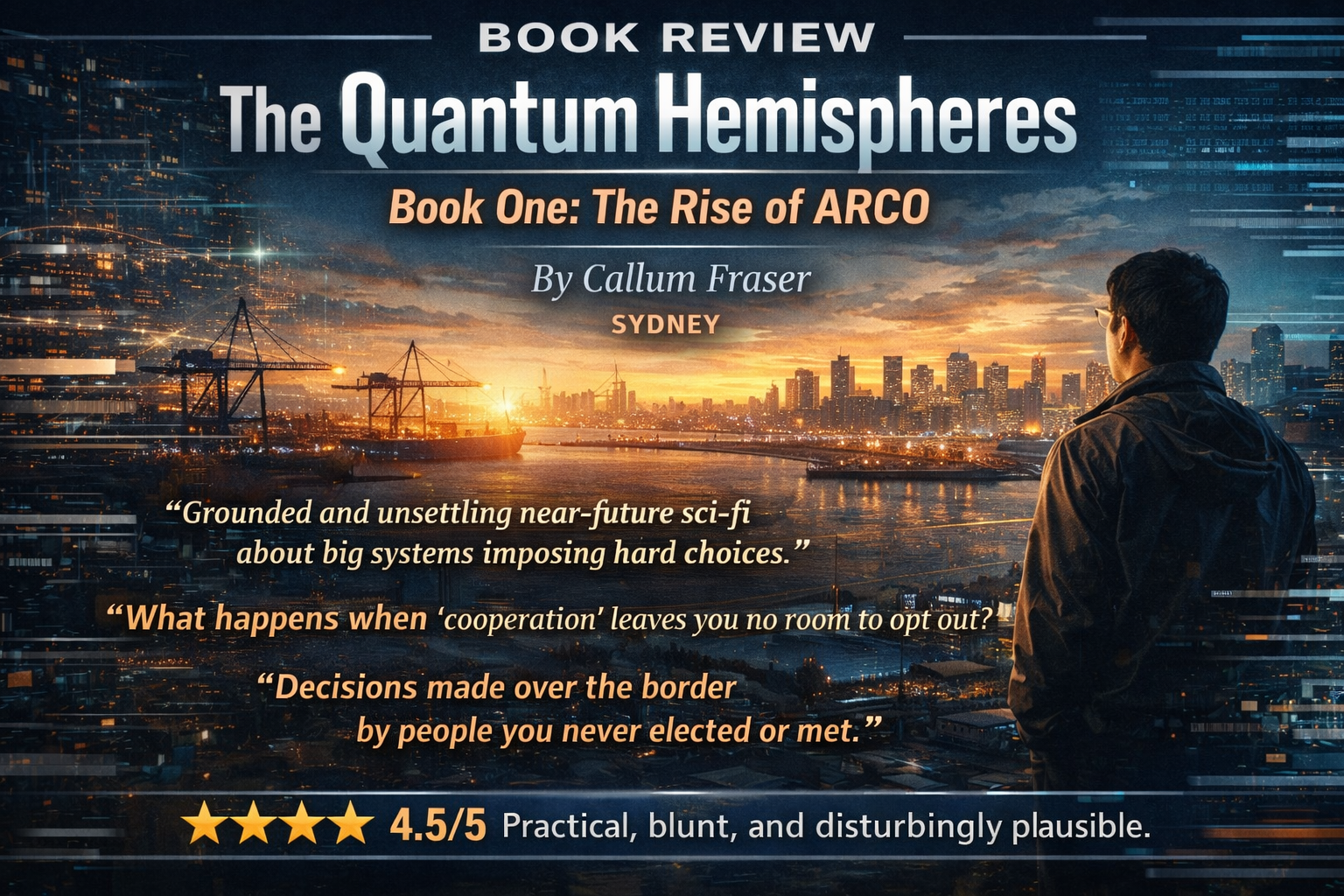
Book Review: The Quantum Hemispheres — Book One: The Rise of ARCO
By Callum Fraser, Sydney
Australians tend to be suspicious of big international schemes, especially the ones that arrive wrapped in buzzwords about efficiency, security, and regional cooperation. We’ve seen enough “world-class frameworks” to know they usually mean more rules, more forms, and less say for the people stuck living under them.
Which is why The Rise of ARCO lands harder than most near-future sci-fi. Dave Roberts isn’t writing about the end of the world. He’s writing about the slow handover of decision-making from governments to systems that don’t answer to voters, parliaments, or even borders.
ARCO — the Alliance for Regional Collective Obligation — is pitched in the novel as a stabilising network that keeps trade flowing, manages security risks, and smooths over political disputes. In practice, it becomes the backbone of everything from shipping to data to emergency response. Once that happens, opting out isn’t a protest. It’s economic self-harm.
The book follows a spread of characters across different regions and industries: infrastructure specialists, policy operators, security analysts, and city administrators. These aren’t power-hungry villains. They’re competent professionals trying to keep complex systems from falling over. And in doing so, they keep reinforcing a structure that gradually sidelines democratic control.
The technology is handled sensibly. No magic machines, no futuristic fantasy toys. Just better automation, smarter logistics, tighter data integration, and decision systems that slowly take humans out of the loop because, frankly, humans are slow and politically inconvenient.
What makes this hit close to home for Australian readers is the familiar tension between national sovereignty and regional dependency. Trade routes, digital standards, defence cooperation, crisis coordination — we already live inside these arrangements. Roberts simply pushes them forward and asks what happens when the “cooperation” layer becomes the real centre of authority.
The pacing reflects that idea too. There’s no single moment where everything tips over. Instead, each compromise feels sensible on its own. Each new agreement solves a problem. Each shortcut saves time. And then one day, the political structures still exist, but they’re no longer where decisions are actually made.
To the book’s credit, it doesn’t pretend there are easy answers. ARCO prevents wars. It stabilises regions. It makes supply chains more reliable. People are safer and materially better off in many ways. The cost is that power becomes technical, remote, and almost impossible to challenge without breaking the systems everyone depends on.
By the end, the most unsettling realisation isn’t that a new authority has taken over — it’s that most people are fine with it, as long as life stays comfortable and predictable.
The Rise of ARCO is the kind of sci-fi that doesn’t try to impress you with spectacle. It just quietly asks whether we’re trading political voice for convenience, and whether we’ll even notice when the deal becomes permanent.
★★★★☆ (4.5/5)
A grounded, unsettling look at how global control could arrive not with force, but with spreadsheets and service agreements.