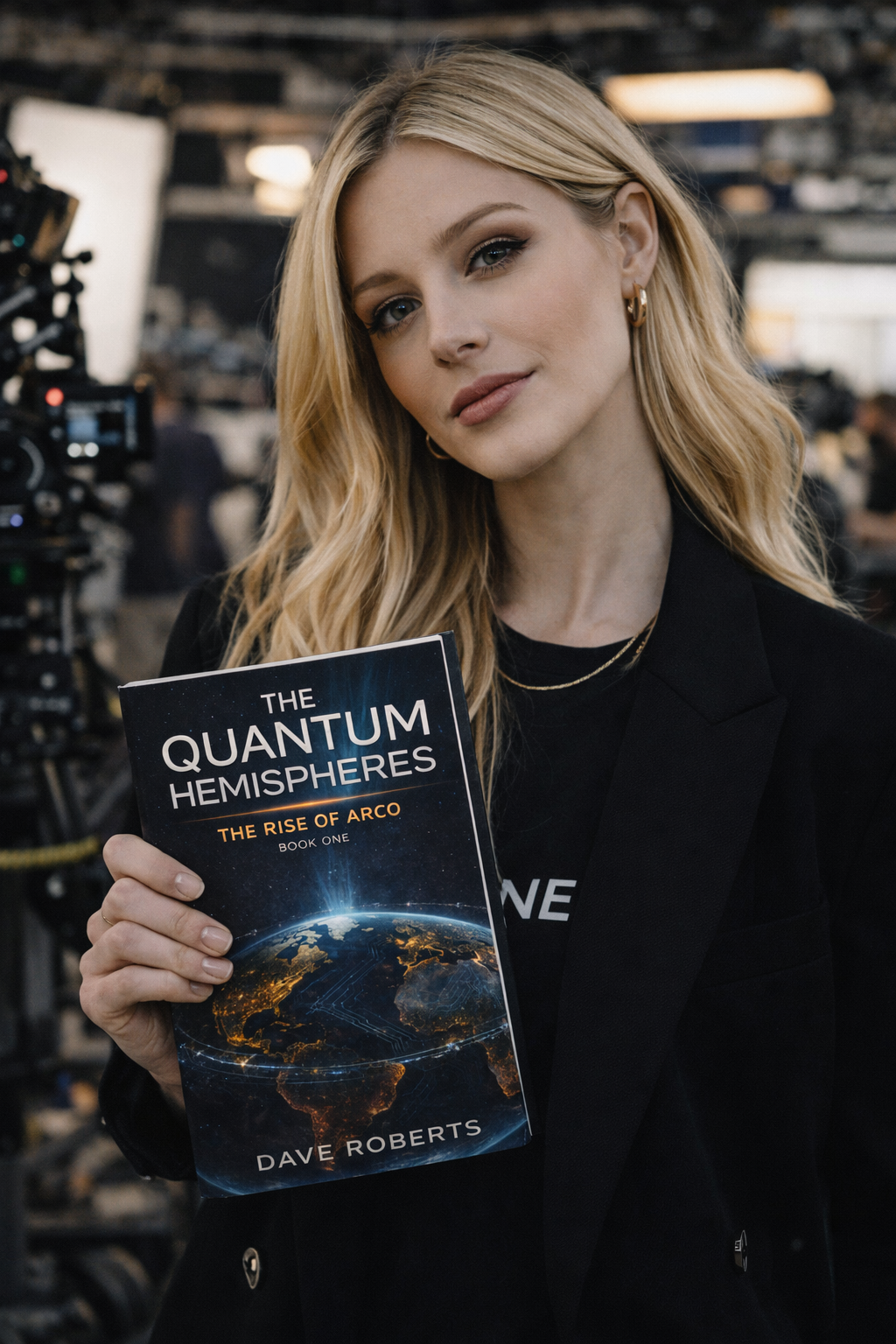
Book Review: The Quantum Hemispheres — Book One: The Rise of ARCO
By Madison Clarke, Los Angeles
I didn’t pick this book up because I was looking for a deep geopolitical sci-fi novel.
A friend handed it to me and said, “This feels like something you’d want to turn into a series.”
They weren’t wrong.
From the first few chapters, what stood out wasn’t just the world-building — it was how visual everything felt. The way the story moves between different regions, systems, and people, it reads like a multi-threaded streaming series already mapped out: overlapping narratives, high-stakes decisions, quiet tension building across continents.
But what really surprised me is that there aren’t obvious “heroes” or “villains.”
It’s not that kind of story.
Instead, you’re watching a world shift — slowly, almost calmly — as power moves into systems that just… work better. Logistics, data, infrastructure, coordination frameworks. Nothing flashy, nothing cinematic in the traditional sense, but somehow it feels bigger than most big-budget sci-fi.
And honestly? That’s what makes it so compelling.
As someone working in film and TV, I kept thinking: this is exactly the kind of story that could translate into a long-form series. Multiple characters across different countries, each dealing with the same system from completely different angles. You could build entire seasons around how ARCO expands, how people react to it, and how the lines between control and cooperation blur.
It has that slow-burn prestige series energy — something between political drama and high-concept sci-fi, but grounded enough that it never feels disconnected from reality.
The ideas in the book are what stay with you though.
It’s not asking, “What if the world ends?”
It’s asking, “What if everything just becomes more efficient… and no one notices what’s changing underneath?”
That’s a very different kind of tension — and it’s way more unsettling.
There were multiple moments where I caught myself thinking, this doesn’t feel like fiction, this feels like direction. Not in a dramatic, alarmist way — just in a quiet, inevitable way.
And that’s what makes it work.
By the time I finished, it didn’t feel like a complete story — it felt like the beginning of something much bigger. Which makes sense, knowing this is the first in a trilogy.
I’m genuinely looking forward to where this goes next.
Also — and I don’t say this lightly — if anyone in development, production, or streaming is paying attention:
This would make a seriously strong TV series.
The structure is already there. The world is already built. The themes are timely without being forced. It just needs the right team to bring it to screen.
So yes, I came into this because a friend recommended it.
I’m leaving it thinking about casting, episode arcs, and how this could look as a global production.
And now I’m waiting for Book Two.
★★★★☆ (4.5/5)
Smart, visual, and quietly intense — with real potential far beyond the page.