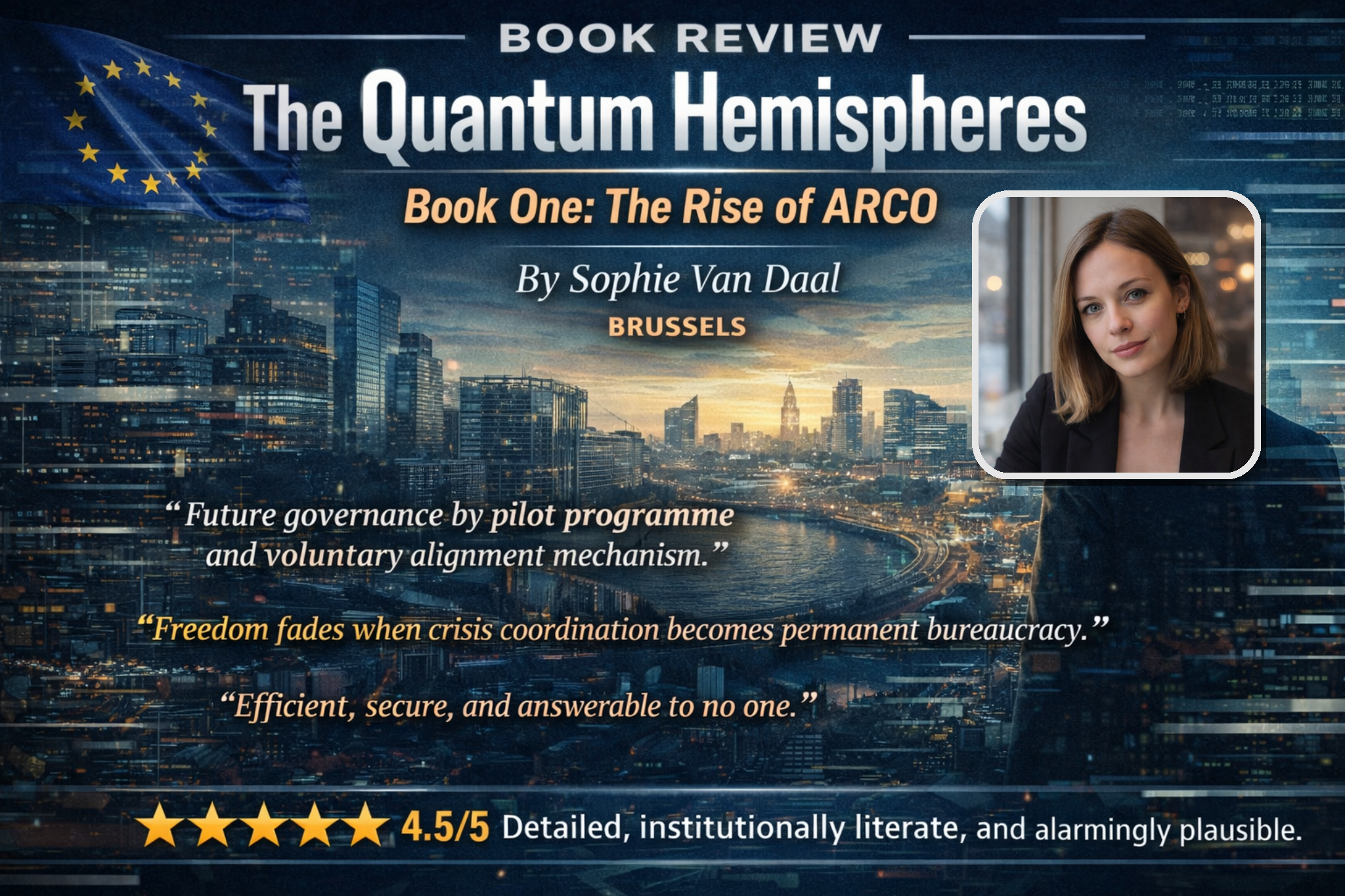
Book Review: The Quantum Hemispheres — Book One: The Rise of ARCO
By Sophie Van Daal, Brussels
Anyone who has spent time around European institutions knows that power rarely arrives wearing a crown. It comes in the form of working groups, framework directives, “voluntary alignment mechanisms,” and pilot programmes that quietly become permanent. The Rise of ARCO understands this dynamic far better than most political thrillers, let alone science fiction.
Dave Roberts’ novel imagines a near future where global authority migrates away from nation-states and into regional alliances that manage trade, security, data, and logistics through integrated systems. On paper, these alliances exist to reduce conflict and improve coordination. In practice, they become the only structures capable of keeping modern economies functioning.
At the centre of the book is ARCO — the Alliance for Regional Collective Obligation — an organisation that does not rule directly, but standardises everything. Regulations align. Technical protocols converge. Infrastructure becomes interoperable. And before long, opting out is no longer a political decision but an economic impossibility.
The story follows a wide cast of professionals: regulators, engineers, intelligence officers, urban planners, corporate compliance specialists. These are not cartoon villains plotting domination. They are people who speak the language of risk management and harmonisation, whose decisions always seem reasonable when taken individually and catastrophic only in hindsight.
Roberts is particularly sharp when it comes to the psychology of institutions. No one in the system believes they are eroding democracy. They believe they are preventing crises, smoothing trade, improving safety, and protecting stability. Political accountability is not abolished — it is simply outpaced by technical necessity.
The technology in the novel is deliberately unglamorous. Automation, sovereign cloud networks, predictive logistics, compliance-driven AI systems — tools that promise efficiency and resilience, while steadily relocating authority from elected bodies to technical administrators. Anyone familiar with how regulatory frameworks actually operate will recognise how realistic this feels.
What gives the book its edge is that ARCO genuinely delivers results. Conflicts decline. Supply chains stabilise. Emergency responses improve. Citizens are safer and more materially secure. The question Roberts forces the reader to confront is whether democratic control survives once governance becomes inseparable from complex technical infrastructure.
The narrative avoids dramatic revolutions or heroic resistance. Instead, it tracks how political relevance erodes through incremental adjustments, treaty addenda, and system dependencies. The world does not fall. It reorganises. And most people adapt, because disruption is always framed as the greater danger.
For European readers in particular, the parallels are hard to ignore: regulatory harmonisation, delegated authority, technocratic crisis management, and the constant trade-off between sovereignty and stability. The Rise of ARCO does not argue that cooperation is evil. It suggests that cooperation, once embedded in critical systems, becomes a form of power that is almost impossible to contest.
By the final chapters, the novel is no longer asking whether ARCO is legitimate. It is asking whether legitimacy still matters once governance is primarily operational rather than political.
This is not dystopia by dictatorship. It is governance by architecture.
★★★★☆ (4.5/5)
A quietly disturbing, institutionally literate novel that understands how control expands not through force, but through frameworks.